Ink Meets Algorithm: Digital Artists Bringing American Craft Back to the Physical World
There's a quiet revolution happening in studios across the country, and it doesn't look like what most people imagine when they hear the word "revolution." No manifestos, no dramatic pivots. Just a growing number of digital illustrators quietly printing their work onto things you can hold, wear, and hang on your wall — and doing it with the same care and intentionality that American artisans have always brought to their trade.
For years, the conversation around digital illustration focused almost exclusively on the screen: social media reach, client deliverables, motion graphics, app design. The physical world felt like a different lane entirely. But something has shifted. Increasingly, US-based digital artists are treating their Procreate files and Illustrator vectors not as endpoints, but as starting points for something more lasting.
Why Now? The Push Toward the Physical
The timing isn't accidental. After years of watching their work scroll past in a matter of seconds, a lot of illustrators started asking a simple question: what if this piece existed somewhere that wasn't a feed?
Chicago-based illustrator Maya Delgado, whose bold, flat-graphic portraits have earned her a loyal following online, started experimenting with risograph printing in 2022. "I'd been making digital work for almost a decade," she says. "And one day I realized I didn't own a single physical piece of my own art. That felt wrong."
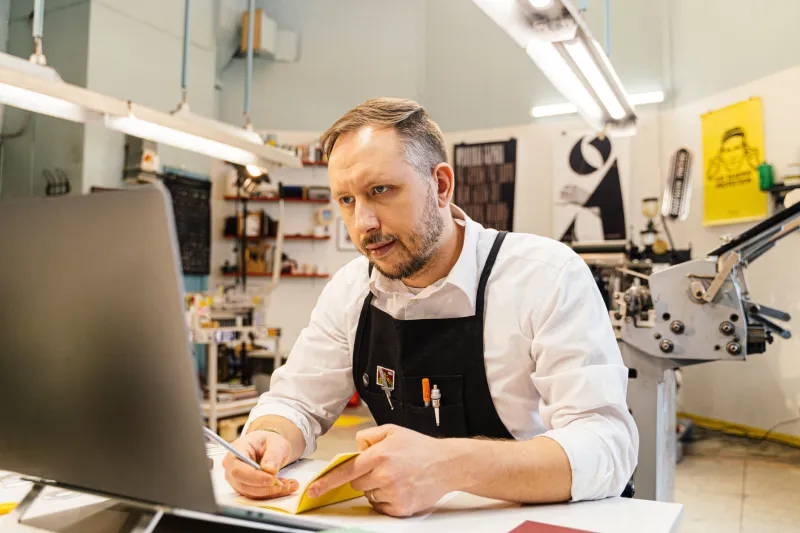
Delgado now runs a small print shop out of her studio, producing limited runs of her illustrations on uncoated stock. Each print sells out within hours. She's not alone. Across cities like Portland, Detroit, Nashville, and Philadelphia, digital illustrators are partnering with local print shops, screen printers, and textile studios to bring their work into the physical realm — and often keeping production deliberately local.
"There's something about working with a printer down the street," says Delgado. "You can go in, look at the proofs together, make adjustments on the spot. It's collaborative in a way that sending a file overseas just isn't."
The American Craft Thread
What makes this movement feel distinctly American isn't just the geography — it's the ethos. There's a long tradition in this country of valuing the handmade, the locally sourced, the thing that has a story attached to it. Think of the Arts and Crafts movement of the early 20th century, the DIY zine culture of the 1980s and '90s, the independent screenprinting boom of the aughts. Each of those moments was, at its core, a reaction against mass production and a reclamation of meaning through making.
Today's digital-to-physical artists are drawing from that same well. Brooklyn illustrator and designer James Okafor, known for his intricate geometric murals, recently completed a public installation in Bushwick that began entirely as a digital mockup. "I designed the whole thing in Illustrator first," he explains. "But the final piece is painted by hand, on a wall that's been there for 40 years. That context matters."
Okafor sees the digital tool as a means to an end — a way to iterate quickly and present ideas to stakeholders before committing to physical materials. The craftsmanship, he argues, happens in both phases. "Precision in the software is its own kind of craft. So is the brushwork. I don't see them as separate."
Apparel as Canvas
Perhaps nowhere is the digital-to-physical movement more visible than in the independent apparel space. A growing number of illustrators are bypassing traditional licensing deals and launching their own small-batch clothing lines, using their digital artwork as the foundation.
Los Angeles-based artist Trina Welles started printing her desert-landscape illustrations onto heavyweight tees and crewnecks two years ago. She works exclusively with a family-owned print shop in the San Fernando Valley. "Fast fashion is everywhere," she says. "I wanted to make something that had a different relationship with the person wearing it. Something they'd actually keep."
Welles's drops are intentionally small — usually 50 to 100 units — and she designs each collection around a specific theme drawn from California's visual history. Her latest series pulls from vintage national park posters and mid-century travel branding. "There's so much rich American design history that's just sitting there, waiting to be reinterpreted," she says. "I want my work to feel like it belongs to that lineage."
The Challenges Are Real
It's worth being honest about the friction involved. Translating digital work to physical formats isn't always smooth. Color profiles shift. Textures that look great on screen can fall flat in print. Minimum order quantities eat into margins. And for artists without prior experience in production, the learning curve can be steep.
"My first print run was a disaster," admits Delgado with a laugh. "The registration was off, the colors were muddy. I lost money on it. But I learned more about color in that one experience than in years of staring at my monitor."
Many illustrators cite that learning process as one of the unexpected benefits of going physical. Understanding how ink sits on paper, how fabric takes dye, how scale affects visual impact — these are lessons that feed back into the digital work itself, making it richer and more considered.
What This Means for American Design Culture
The broader implication of this movement is worth pausing on. At a moment when so much creative work is ephemeral — consumed, liked, forgotten — there's something culturally significant about a generation of digital artists choosing to make things that persist. Things that can be touched, gifted, inherited.
It's a modern expression of an old American instinct: the belief that what you make with your hands (or your tools) says something about who you are and what you value. The medium has changed. The spirit hasn't.
For anyone following American illustration and design, this is one of the most exciting developments in the space right now. Keep an eye on your local print fairs, independent markets, and community murals. The next great American craft moment might be loading on a printer right down the street.